Renewable Energy World
For people who own rooftop power systems, solar adds value to the home -- about $25,000 for the average installation in California, according to a study in December by the Lawrence Berkeley National Laboratory, funded by the U.S. Energy Department’s SunShot Initiative. Leased systems are another story because they’re considered personal property rather than part of a house. For many potential buyers, a solar lease is a liability rather than an asset, and may drive some people away.

Mostrar mensagens com a etiqueta aplicações. Mostrar todas as mensagens
Mostrar mensagens com a etiqueta aplicações. Mostrar todas as mensagens
sexta-feira, 27 de junho de 2014


terça-feira, 27 de março de 2012
3D PV
R&D Mag
Building cubes or towers that extend the solar cells upward in 3D configurations. Amazingly, the results from the structures they've tested show power output ranging from double to more than 20 times that of fixed flat panels with the same base area. The biggest boosts in power were seen in the situations where improvements are most needed: in locations far from the equator, in winter months and on cloudier days. The new findings, based on both computer modeling and outdoor testing of real modules, have been published in Energy and Environmental Science. (...) "Even 10 years ago, this idea wouldn't have been economically justified because the modules cost so much," Grossman says. But now, he adds, "the cost for silicon cells is a fraction of the total cost, a trend that will continue downward in the near future." Currently, up to 65% of the cost of photovoltaic (PV) energy is associated with installation, permission for use of land, and other components besides the cells themselves.
Check the original paper for details.
Building cubes or towers that extend the solar cells upward in 3D configurations. Amazingly, the results from the structures they've tested show power output ranging from double to more than 20 times that of fixed flat panels with the same base area. The biggest boosts in power were seen in the situations where improvements are most needed: in locations far from the equator, in winter months and on cloudier days. The new findings, based on both computer modeling and outdoor testing of real modules, have been published in Energy and Environmental Science. (...) "Even 10 years ago, this idea wouldn't have been economically justified because the modules cost so much," Grossman says. But now, he adds, "the cost for silicon cells is a fraction of the total cost, a trend that will continue downward in the near future." Currently, up to 65% of the cost of photovoltaic (PV) energy is associated with installation, permission for use of land, and other components besides the cells themselves.
Check the original paper for details.
terça-feira, 14 de dezembro de 2010
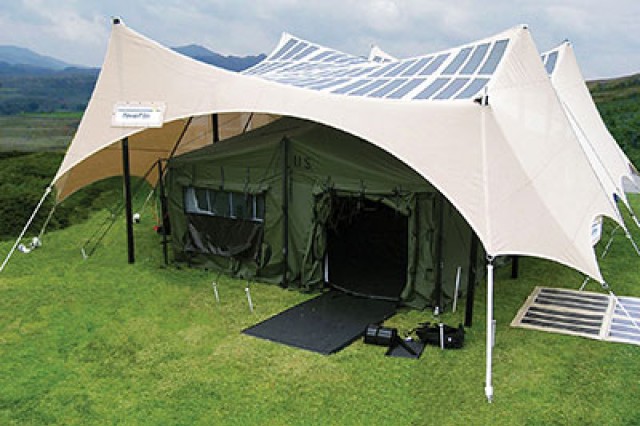
Army evaluating transportable solar-powered tents
www.army.mil
The U.S. Army is evaluating a host of flexible, portable, lightweight solar-powered shades and tent-like technologies. The products are designed to allow expeditionary units to deploy with transferrable, exportable electrical power that can charge batteries, computers and other essential gear without needing fuel or a generator, service officials said. (...) The TEMPER Fly is a roughly 16-by-20-foot tent structure able to generate 800 watts of electricity. A QUADrant is a smaller variant of the TEMPER Fly, able to generate 200 watts of power, and the Power Shades range in size and are capable of generating up to 3 kilowatts of exportable electrical power, Tucker said. The PV integrated military shelter items use a lamination process to combine the PV materials [Flexible PV, amorphous silicon] into the textile substrate, Tucker [a senior engineer in the Shelters Technology, Engineering and Fabrication Directorate at the Natick Soldier Research Design and Engineering Center] explained.

The U.S. Army is evaluating a host of flexible, portable, lightweight solar-powered shades and tent-like technologies. The products are designed to allow expeditionary units to deploy with transferrable, exportable electrical power that can charge batteries, computers and other essential gear without needing fuel or a generator, service officials said. (...) The TEMPER Fly is a roughly 16-by-20-foot tent structure able to generate 800 watts of electricity. A QUADrant is a smaller variant of the TEMPER Fly, able to generate 200 watts of power, and the Power Shades range in size and are capable of generating up to 3 kilowatts of exportable electrical power, Tucker said. The PV integrated military shelter items use a lamination process to combine the PV materials [Flexible PV, amorphous silicon] into the textile substrate, Tucker [a senior engineer in the Shelters Technology, Engineering and Fabrication Directorate at the Natick Soldier Research Design and Engineering Center] explained.
sexta-feira, 18 de junho de 2010
Óculos escuros usam energia solar para abastecer gadgets
A função primária dos óculos escuros é a de proteger os olhos dos poderosos raios solares, mas além de ser uma ferramenta de segurança ou de estética, não há nenhuma outra função declarada do objeto. Os designers sul-coreanos Hyun-Joong Kim e Kwang-Seok Jeong prezaram pela sustentabilidade e resolveram ir além: desenvolveram o SIG, ou Self-energy Converting Sunglasses. A ideia é não desperdiçar a luz solar que incide nos óculos e cultivá-la, transformando-a em energia elétrica para alimentar qualquer gadget que o usuário possua, como telefones celulares ou tocadores de mp3. A saída de energia fica escondida atrás da perna do óculos que usa nanotecnologia para funcionar: as lentes são tingidas com uma tinta especial que possui nanocélulas solares que se encarregam de converter a luz do sol em energia elétrica.

A função primária dos óculos escuros é a de proteger os olhos dos poderosos raios solares, mas além de ser uma ferramenta de segurança ou de estética, não há nenhuma outra função declarada do objeto. Os designers sul-coreanos Hyun-Joong Kim e Kwang-Seok Jeong prezaram pela sustentabilidade e resolveram ir além: desenvolveram o SIG, ou Self-energy Converting Sunglasses. A ideia é não desperdiçar a luz solar que incide nos óculos e cultivá-la, transformando-a em energia elétrica para alimentar qualquer gadget que o usuário possua, como telefones celulares ou tocadores de mp3. A saída de energia fica escondida atrás da perna do óculos que usa nanotecnologia para funcionar: as lentes são tingidas com uma tinta especial que possui nanocélulas solares que se encarregam de converter a luz do sol em energia elétrica.

quarta-feira, 10 de março de 2010
Solar Power for Buses
SunPods Inc., a California-based manufacturer of modular, fully integrated and tested solar power generation systems, and Bauer Intelligent Transportation, a leading provider of chauffeured green transportation, recently teamed up to create what they say is the "first solar power-assist system for buses." (...) The SunPods Sun Bus Power System "consists of four thin film solar panels that run the length of the bus and charge an on-board battery bank. When the bus engine is off, the batteries power the air-conditioning and wireless connectivity equipment, enabling transportation companies to effectively meet anti-idling standards without compromising passenger comfort."
SunPods Inc., a California-based manufacturer of modular, fully integrated and tested solar power generation systems, and Bauer Intelligent Transportation, a leading provider of chauffeured green transportation, recently teamed up to create what they say is the "first solar power-assist system for buses." (...) The SunPods Sun Bus Power System "consists of four thin film solar panels that run the length of the bus and charge an on-board battery bank. When the bus engine is off, the batteries power the air-conditioning and wireless connectivity equipment, enabling transportation companies to effectively meet anti-idling standards without compromising passenger comfort."
quarta-feira, 9 de dezembro de 2009
Scarecrow Bio-Acoustic Systems has launched COMPACT – the solar powered scarecrow
It may be powered from 15V DC, 110V/250V AC mains supplies, or from a leisure battery, fully maintained by solar panels. The solar powered scarecrow incorporates a bio-acoustic bird dispersal system using natural species distress calls to create an environment appearing ‘hostile’ to birds. It is humane, inoffensive and does not endanger their lives.

It may be powered from 15V DC, 110V/250V AC mains supplies, or from a leisure battery, fully maintained by solar panels. The solar powered scarecrow incorporates a bio-acoustic bird dispersal system using natural species distress calls to create an environment appearing ‘hostile’ to birds. It is humane, inoffensive and does not endanger their lives.

Subscrever:
Mensagens (Atom)

 Mensagens

